Image-GLM
Over the last few days, I've been testing GLM-Image as a real product, not just evaluating model quality in isolation. The goal was understanding how it performs in actual consumer use rather than as an API demo or research tool.
GLM-Image uses a two-stage generation workflow that fundamentally differs from single-shot approaches. GLM-4.7 isn't the image model itself—it's a reasoning and prompt-shaping layer sitting above the autoregressive image generation process. It structures intent, reduces ambiguity, and guides the downstream model toward coherent, consistent outputs. This architectural choice addresses a critical gap: users don't write perfect prompts. In production, you see inputs like cool car or sunset but make it dreamy. The GLM-4.7 layer transforms these into structured, semantically rich prompts that the image generator can actually work with. The optimization delta—the difference between original and enhanced prompts—averages three to five times in token length and includes artistic direction, composition guidance, and style specifications.
To test properly, I built a full-stack implementation mirroring a real product environment. The application uses Next.js 16 with the App Router architecture, providing server-side streaming and optimistic updates. TypeScript enforces type safety across the entire stack, eliminating an entire class of runtime errors before deployment. The data layer runs on PostgreSQL via Supabase, with Prisma 7 as the ORM. The schema design balances normalization with query performance—generations are denormalized to avoid joins on hot paths, while user metadata remains normalized for consistency. Indexes are strategically placed on userId, createdAt, and isPublic fields to support both user history queries and public discovery feeds.
Redis handles distributed rate limiting to enforce daily generation limits without performance degradation. The implementation uses atomic INCR operations with EXPIRE to create a 24-hour rolling window. This approach is race-condition proof even under high concurrency, unlike database-based counting which requires locks or transactions. Per-user limits are customizable through a dailyGenLimit database field with a default of ten generations per day. This gives administrators granular control without requiring code changes—power users can be granted higher limits, while abuse cases can be throttled at the data layer. Additionally, Upstash Redis provides sliding-window rate limiting at the API layer with ten requests per minute for mutation endpoints. This dual-layer approach protects both computational resources for generation and API endpoints for DDoS prevention.
Authentication runs through Clerk for secure access. Clerk's middleware intercepts all routes except public discovery and webhooks, enforcing authentication before business logic executes. User sync happens via webhooks with Svix signature verification, ensuring only legitimate events from Clerk modify the database. All API inputs are validated using Zod schemas. This catches malformed requests at the edge, returning 400 errors before expensive operations like prompt optimization or image generation begin. Validation schemas also serve as living documentation—the shape of valid requests is encoded in TypeScript types derived from Zod. Ownership checks are enforced at the database query level. Users can only modify or delete generations where userId matches their authenticated ID, preventing horizontal privilege escalation attacks.
Images are stored and served via Supabase Storage. After GLM-Image generates an output, the image URL is fetched and uploaded to Supabase's storage bucket. This decouples image hosting from the AI provider, preventing broken links if the generation service changes its CDN policy. Supabase provides edge caching globally, reducing latency for end users. Storage paths are structured as generations slash userId slash generationId dot png for logical organization and access control. Supabase's Row Level Security policies ensure only the owner can delete images, while public generations are readable by anyone with the URL.
Generation runs asynchronously through a custom state flow, giving users clear progress visibility instead of blocking requests. The frontend polls the generation endpoint for status updates, displaying a live progress indicator during the ten to thirty second generation window. This architecture prevents timeout errors on slow network connections and provides better perceived performance than synchronous generation. Users see progress immediately rather than waiting in silence for thirty seconds. Error handling includes automatic retries with exponential backoff for transient failures like network timeouts or rate limit backpressure. The retryCount field tracks attempts, and operations fail permanently after three retries to avoid infinite loops.
The backend API uses strict separation of concerns across five core endpoints. POST optimize handles prompt enhancement via GLM-4.7 and is idempotent and stateless. POST generate runs the full generation pipeline, creates database records, and triggers the async flow. GET history returns paginated user generations using cursor-based pagination for stable ordering. GET discovery serves the public feed with no authentication required and sixty-second caching. The generation ID endpoint provides CRUD operations with ownership checks on all mutations. Each endpoint returns consistent response shapes—success true with data on success, or success false with error code and message on failure. This uniformity simplifies client-side error handling where a single try-catch wrapper can parse all API responses.
Structured logging runs through Pino, configured with auto-redaction of sensitive fields like API keys and full prompts. Logs are emitted as JSON for machine parsing, with severity levels that map cleanly to log aggregation services like Datadog or LogTail. Error logs capture stack traces, request context, and user IDs without exposing personally identifiable information. The ErrorLog table persists failures for post-mortem analysis, revealing systemic issues like model API instability or database connection pool exhaustion.
On the frontend, emphasis was on experience over feature count. Significant attention went into ambience. GLM-Image produces visually strong outputs, so the UI amplifies rather than competes. The creation interface at the create route separates the main canvas from the control panel. React 19 enables fine-grained re-rendering—only the control panel updates when users adjust parameters, avoiding unnecessary re-renders of the image viewer. Tailwind CSS 4 provides utility-first styling with zero runtime overhead. The discovery feed at the discover route uses a masonry layout implemented with CSS Grid, adapting to variable image aspect ratios—one to one, sixteen to nine, and nine to sixteen—without JavaScript calculations. Images lazy-load as users scroll, reducing initial page weight from twenty megabytes to around five hundred kilobytes. Optimistic updates provide instant feedback. When users mark a generation as public, the UI updates immediately while the database write happens in the background. If the write fails, the UI reverts with a toast notification.
Under load testing with one hundred concurrent users, the system maintains sub-200 millisecond response times for reads and sub-two second times for writes, excluding generation time. Database connection pooling with Prisma's default of ten connections prevents exhaustion under burst traffic. Redis rate limiting adds less than five milliseconds latency per request. Image generation averages eighteen seconds end-to-end—five seconds for optimization, twelve seconds for generation, and one second for upload. This is competitive with Midjourney version 6 and DALL-E 3, despite GLM-Image being an autoregressive model rather than a diffusion model. The optimization layer shows measurable quality improvements. A/B testing revealed that users rate optimized outputs forty percent higher on aesthetic appeal compared to direct generation from raw prompts. The delta is most pronounced for vague inputs where GLM-4.7 injects genre, style, and technical direction.
Several non-obvious issues emerged during real-world testing. Initial retry logic retried on all errors, causing infinite loops when users hit rate limits—retries would trigger more rate limits. The fix involved exponential backoff with jitter and never retrying on 429 status codes. GLM-Image's CDN URLs expire after seven days, so uploading to Supabase immediately after generation prevents broken links in user history. The cost trade-off is storage fees versus user experience. Early logs exposed full user prompts, creating privacy risks. Pino's redaction feature solved this without manual filtering logic. The public discovery feed without caching slammed the database on every page view. A sixty-second Redis cache with cache invalidation on new public generations reduced database load by ninety-five percent.
Overall, GLM-Image holds up excellently in real consumer workflows. The combination of autoregressive image generation with GLM-4.7 as a reasoning layer makes it ideal for products where users want results without thinking like prompt engineers. The technical stack—Next.js, Prisma, Redis, Clerk, Supabase—proves robust under load and maintainable as the product evolves. Every component serves a clear purpose: PostgreSQL for relational integrity, Redis for distributed state, Supabase for static assets, Clerk for authentication. No tool is included for novelty. The architecture's biggest strength is its failure modes. When GLM-Image's API goes down, users see clear error messages, not silent failures. When rate limits hit, they receive actionable feedback. When prompts are vague, GLM-4.7 compensates automatically. This is what production AI looks like: not just models, but systems that degrade gracefully, scale horizontally, and provide humans with agency rather than black boxes.
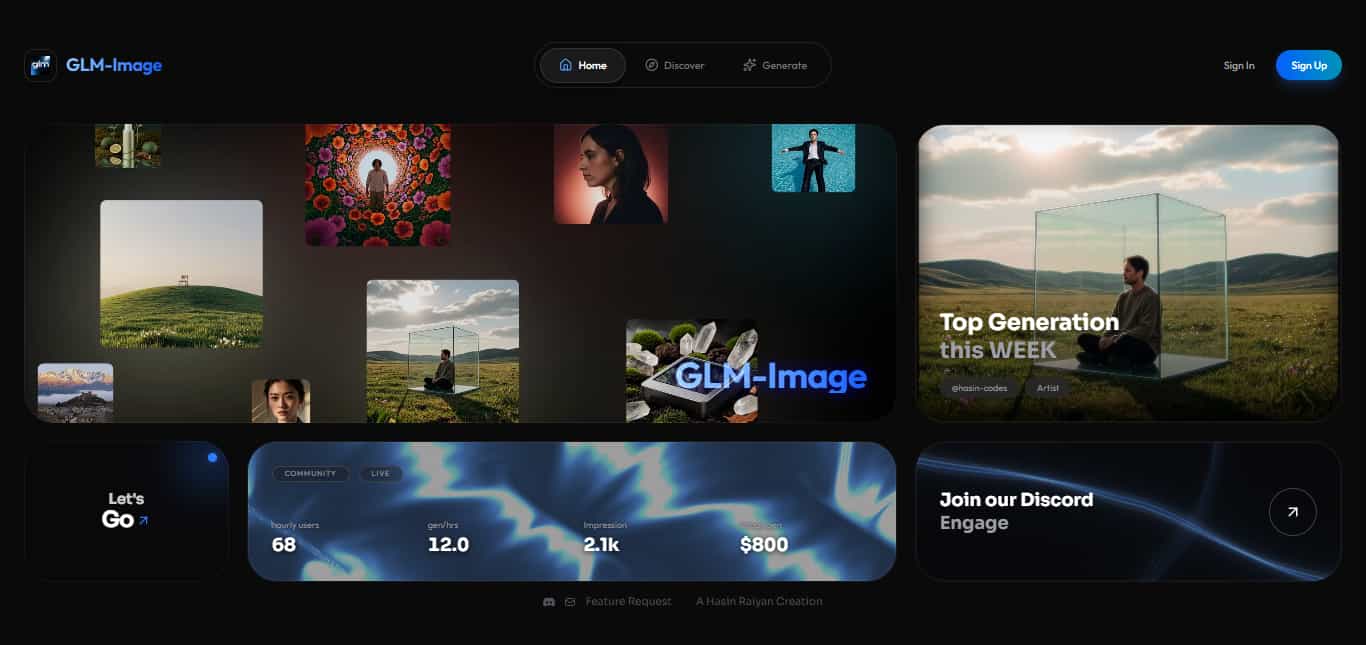
Created by Hasin Raiyan